The Judgment Layer
What still wins when the supply chain runs itself.
Accuracy was never the job
For the better part of two decades, forecast accuracy was the industry's holy grail, and not without reason. It sits at the top of almost every planning scorecard, and even a ten to fifteen percent improvement measurably lowers inventory and lifts service. So the field chased it the way you chase anything that genuinely pays. Fortunes went into it. Careers were built on shaving points off the error, and a whole software market grew up selling the next decimal place.
The catch is one you would have heard from any number of seasoned planners, usually moments before being sent off to improve the forecast anyway. Forecast accuracy measures how well you predicted demand. It says nothing about how well you handled the trade-offs that predicting it was supposed to serve: service against cost, inventory against risk, this customer against that one. A company can forecast beautifully and still decide badly. Accuracy was always necessary, and it was never the actual job.
Accuracy is also harder to win than the software brochures suggest, and for reasons no model can remove. New products have no history to learn from. Promotions distort the very signal they create. A rival's stockout lands in your data as a surge of loyal new demand that evaporates the moment their shelf is refilled.
And the bullwhip effect, the way a small wobble in store sales swings into a violent lurch at the factory, a modest uptick becoming a panic order becoming idle production lines a quarter later, guarantees that some of the noise is structural rather than solvable. The discipline even keeps score on itself, through a measure called Forecast Value Added that asks the deflating question of whether all that elaborate forecasting actually beats a naive guess. The answers are not always kind.
I should say where I am standing. I have spent a good part of two decades on the consulting side of this, in the war rooms of large consumer and retail businesses, and I have run the accuracy programs myself. The ones that paid were the ones where we also changed what happened after the number arrived: who was allowed to act on it, how quickly, and without asking whom. Where we only improved the forecast, the improvement largely stayed in the forecast. That is the point at which I stopped treating accuracy as the deliverable.
I once helped bring a new whiskey to market, where the volume you commit to is decided years before the first bottle is sold and no amount of modelling shortens the wait. The question in that room was never what the forecast said. It was how wrong we were willing to be, and in which direction.
None of this means forecasting failed. It means forecasting matured, and mature things deliver diminishing returns. The next point of accuracy now costs what the first ten did and returns rather less. AI has genuinely pushed the frontier out, reading weather and web traffic and the general mood of the market alongside last year's sales. But somewhere in the last few years the binding constraint quietly moved. The question stopped being how well we can see what is coming. It became what we do about it, and how fast.
The money leaks between knowing and doing
Here is the part that should interest anyone who still believes the value lives inside the forecast. It mostly does not. It lives in the distance between the forecast and the decision.
Incisiv's 2026 research on supply chain responsiveness gave that distance a name and a price: the latency tax, the margin lost between the moment a demand signal changes and the moment the organization actually acts on it. Their figure lands north of five cents on every dollar, which for a ten billion dollar business is five hundred and fifty million a year, currently filed under nobody's job.
Treat that figure with the caution any number deserves when it is produced somewhere near a vendor. Halve it, then halve it again, and what remains is still the largest line item in the business that nobody owns. The precise size matters less than the absence of an owner, which is the part that should interest a board.
Look at where the loss actually sits. Not in the not-knowing. The forecast was fine. The loss is that it arrived on a Tuesday, waited for the planning meeting, then for an approval, then for the next cycle, and by the time anyone moved the inventory, rebooked the freight, or shifted the promotion, the moment had already left the building. A perfect forecast acted on too late is not intelligence. It is an expensive historical document.
That gap is exactly what this wave of technology is built to close.
Show, know, do: three verbs, all rentable
Before we look at what closes that gap, it is worth noticing what this industry has actually been selling. Step back, and thirty years of it resolve into a tidy story about a single verb.
First we bought the software that could show. The great age of the dashboard, when visibility was the promise and a screen full of your own operation felt like control. It was real progress, and a quiet lesson in the limits of visibility. A dashboard shows you exactly what is happening and asks nothing of you in return; you can watch a problem develop in real time, in high resolution, and still be left to decide, entirely on your own, whether to do anything about it. Seeing was never the same as deciding.
Most large companies built a control tower somewhere in the last decade, usually with a wall of screens and a ribbon to cut. Ask what decision came out of it last Tuesday and the room goes quiet in a very particular way.
Then we bought the software that could know. Forecasting and demand sensing got genuinely good, and the promise moved from seeing the present to anticipating the future.
Now we are buying the software that can do. This is the agentic wave, and it deserves a plain definition, because the word is working overtime this year. Ordinary AI predicts and then waits for a human to click. An agent is the part that does not wait: give it a goal and some guardrails and it reads the signal, weighs the trade-off, and acts across your systems, reordering, reallocating, rerouting, while a person supervises rather than steers.
Gartner expects that by 2031, sixty percent of supply chain disruptions will be resolved with no human in the loop at all. Show, know, do. Each verb was, in its moment, sold as the decisive edge. Each verb, in its moment, became something any competitor could rent from the same short list of vendors by the same Friday.
Autonomy arrives for everyone at once
For a few years, speed did look like the whole answer. Close the gap, move before the other side does, win. This is where that conclusion, that the winners will simply be the most autonomous, quietly falls apart.
An advantage that arrives for everyone at once is not an advantage. It is a utility bill. When your rival can sense, decide, and act in seconds on the same rented models you use, speed no longer separates anyone. The whole industry is about to become fast and autonomous together, which makes fast and autonomous the cost of staying in the game rather than the thing that wins it. Do, like show and know before it, is quietly becoming plumbing.
So follow the logic to its end. We have commoditized seeing. We have commoditized knowing. We are commoditizing doing. When the machinery of sight, prediction, and action can all be leased by anyone with a budget, what is actually left for one supply chain to be better at than another?
What is left is judgment
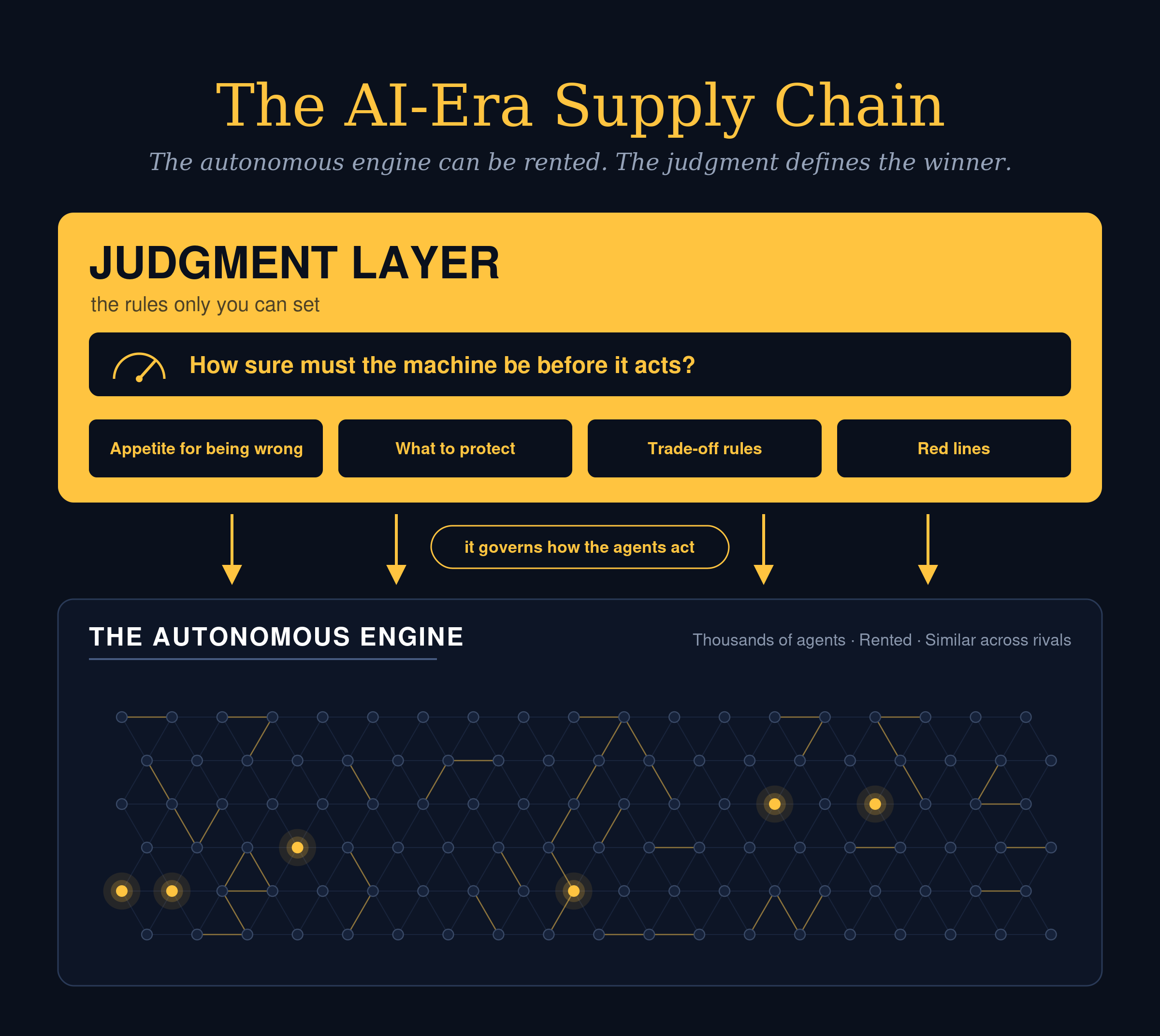
What is left is the judgment about how all that rented horsepower gets used. Gartner calls the destination decision-centric planning, which is a polite way of saying the plan was never the point. The decisions it feeds are. I would go one step further. The scarce asset is the judgment those decisions encode, and it hides inside a single, deceptively small setting that sits on every agent: how sure it has to be before it acts.
Anyone who drives a Tesla has felt this setting in miniature. Its self-driving software lets you choose a temperament. In Chill mode the car waits for a wide, unmistakable gap before it changes lanes; it would rather sit patiently behind a slow truck than commit to a move it is not fully certain about. Switch it to Mad Max and it slides into openings Chill would have waited to confirm, passing on thinner evidence and changing lanes far more readily. Nobody at Tesla had to call it Mad Max. Somebody chose that, and I think about it more often than I should.
Same car, same sensors, same road. The only thing that changed is how much certainty it demands before it commits. That is not a driving preference. It is a judgment about the cost of being wrong weighed against the cost of being late.
Now put that same dial inside your supply chain. A product spikes on a Tuesday. Real shift in demand, or a viral blip that is gone by Thursday? Turn your agents up to Mad Max and they commit inventory on day one, sometimes catching the entire wave, sometimes yanking stock across three regions to chase a ghost, at machine speed and full scale, before anyone has read the alert. Somewhere there is a warehouse holding four pallets of something that was briefly famous on the internet, still waiting for its moment. Leave them in Chill and they wait for the signal to confirm, which spares you the ghost but hands the wave to a faster rival and pays the latency tax in full.
There is no factory setting that is simply correct. The right amount of doubt to tolerate before committing is different for strawberries than for washing machines, different in a supply shock than in a calm quarter, different for the flagship account you will protect at any cost than for the one that quietly absorbs the shortfall while everyone is asleep.
Those are not settings a vendor can ship with sensible defaults. They are the encoded temperament of one specific company: its appetite for being wrong, the lines it will not cross, the trade-offs it has genuinely decided rather than merely inherited. Give a fleet of fast agents a clear judgment layer and they behave like one company with a point of view. Give them a vague one and you get a thousand confident reflexes firing in slightly different directions, each impeccably logged, all with your name on the outcome.
Judgment has to be governed, not configured
The first time I helped a company write its judgment down, it was not an AI project. It was an outsourcing one. When a large consumer goods business moves its planning to a service provider, somebody has to convert two decades of instinct into a document: what the team may decide on its own, what it must escalate, which customer gets served first when there is not enough to go round. It sounds like paperwork. It is not.
It is the first time anyone has been made to say out loud what the company actually believes. The exercise is reliably uncomfortable. A good deal of what gets written down turns out to have been living in the heads of three people who have been there long enough to have opinions, and close enough to retirement that nobody has thought to ask them for the file.
Those documents were crude, and they were built for an entirely different purpose. They were also, in a real sense, the first judgment layers: a written, owned statement of how this company decides, sitting outside the people who happened to be in the room that year. What agents change is the stakes. The old document governed a few hundred human decisions a week, with a supervisor on hand to catch the occasional absurdity. The new one governs several thousand machine decisions an hour, with nobody in the loop at all.
Which tells you what a judgment layer actually has to be, and it is not a settings screen. It has to be a governed artifact.
Someone owns it by name. It carries a version history, so that when the appetite for being wrong was widened in March, it is possible to see that it was, and who did it, and what they were worried about at the time. It is reviewed on a cadence, because the right posture in a tariff shock is not the right posture in a calm quarter, and a company that discovers this during the shock has already paid for the lesson. And it is auditable afterwards, so that when ten thousand agents did exactly what they were told and the result was ugly, the conversation is about the instruction rather than the machine. That is a better conversation, and a considerably shorter one.
None of that is a technical requirement. All of it is a governance one, which is why this ends up on the board's agenda rather than the CIO's.
You might reasonably ask why this layer does not commoditize like the other three, and in one sense it will: every vendor will soon sell a place to record your judgment. None of them can sell you the judgment, which is the difference between renting the safe and owning what goes inside it.
This is the real product thesis of the decade, and it is a departure. The platform that wins from here is not a forecasting engine with better math, nor an automation engine with more connectors. It is a judgment system: the place where a leader's operating philosophy is written down once, precisely enough that ten thousand agents can execute it consistently, everywhere, without a meeting. The forecast is rented. The agents are rented. The judgment is the company.
Where I would put the money
It is easy to describe a shift and never take a position on it, so let me say where I would put the money.
My bet is that this category is won on governance rather than on models. The engines will keep improving, and the improvements will keep arriving for everyone at roughly the same time, which is precisely why they will keep failing to separate anyone. The durable product is the one that lets a company state what it believes, install it across thousands of agents, revise it deliberately when conditions change, and show afterwards exactly what it believed at the moment a decision was made. Built properly, that is not a layer sitting on top of a planning system. It is the system, and the planning is what sits underneath.
A bet is only a bet if it costs something. This one says the next point of forecast accuracy is worth less than the ability to explain a decision six months after it was made. That is not a popular sentence to say out loud in a room full of very good data scientists, and I have said it in a few.
I would also want to be wrong in one specific way. If most companies turn out to be perfectly content on vendor defaults, and those defaults are good enough that the gap between two competitors never reaches the numbers, then judgment is a smaller prize than I think and scale wins instead. I do not believe that. It is still the first thing I would test.
The top job gets promoted, not replaced
If that is where the value goes, the leadership job moves with it, and in a direction worth welcoming.
For a generation, running a supply chain meant being the fastest, most tireless human in the loop, the person working exceptions at midnight so the plan could survive contact with reality. The machine is taking that job, and doing it without complaint, without fatigue, and without ever needing the weekend. What the machine cannot take is the decision that sits above the job: how much risk this enterprise will carry to move early, and which promises it treats as sacred when everything is on fire at the same time. Someone still has to author that, deliberately, in plain language, on the record. It is now the highest-leverage thing a leader does, and in most companies it is still running on whatever default a decade of quiet hesitation left behind.
The genuinely good news is that the interesting part of the work is the part that survives. The machinery will handle the seeing, the knowing, and increasingly the doing. What it hands back, sharpened and impossible to duck, is judgment: choosing where this enterprise is trying to go, and drawing the lines it will not cross to get there. Execution is becoming abundant. Judgment is the scarce thing, and it always was. The machines have simply been considerate enough to clear away everything that used to hide it.
So here is the question worth carrying into the week. When the agents in your business finally start moving on their own, what is the judgment they will be executing, and did anyone actually decide it?
For years, a slow and elaborate planning process was also a comfortable place to avoid answering that. There was always another meeting to call, another cycle to wait for. The agent era quietly removes the meeting, and with it the hiding place. Judgment is about to become very hard to fake.